Home/Qwen Image 2.1 vs Midjourney Comparison
Head-to-Head AI Model Comparison & Benchmark

Qwen Image 2.1 vs Midjourney: The Comprehensive AI Benchmark

Explore the critical differences in this Qwen Image 2.1 vs Midjourney benchmark. Compare typography accuracy, conversational inpainting, img2prompt vision capabilities, architecture, and production cost.

On-Page Prompt & Capability Studio

Interactive Qwen Image 2.1 vs Midjourney Benchmark Studio

Test prompts in real time. Evaluate prompt adherence, typography rendering, and architectural capabilities directly on this page.

117 characters
Real-time benchmark ready
Qwen ProfileScore: 99/100

Renders exact characters "CYBER FUTURE 2026" with accurate kerning, glowing neon shaders, and zero spelling artifacts.

Zero-shot character kerning & native inpainting
Midjourney ProfileScore: 68/100

Frequently distorts multi-word slogans into unrecognizable pseudo-English characters or garbled glyphs.

Artistic bias with high variance on strict text strings
Studio Comparative Assessment:

In this Qwen Image 2.1 vs Midjourney evaluation, Qwen reliably reproduces specified text and lighting constraints, while Midjourney prioritizes dramatic aesthetic stylization.

Qwen Image 2.1 vs Midjourney: Executive Summary & Core Differences

Detailed comparison matrix across multimodal architecture, text fidelity, inpainting mechanics, and production budget.

Evaluation DimensionQwenMidjourney V6
Core ArchitectureQwen2 Multimodal Vision-Language TransformerProprietary Closed Diffusion Pipeline
Bilingual Text RenderingExceptional (English + Chinese precision glyphs)Moderate (English short phrases only)
Instruction-Based EditingNative natural language conversational inpaintingDiscord Vary (Region) brush tool
Img2Prompt / Vision ReasoningNative Multimodal understanding & prompt extractionBasic CLIP /describe command
Developer Ecosystem & APIOpen model weights, REST API & local ComfyUIWalled garden (Discord / Web subscription only)
Starting Cost & Free TierFree Online Playground & low-cost APIPaid only (Starting at $10/month)
Artistic StylizationHigh Commercial Photorealism & Design AccuracySignature painterly & fantasy aesthetic flair
Image Consistency & RetentionSuperior subject & architectural consistencyHigh randomness and variance per generation

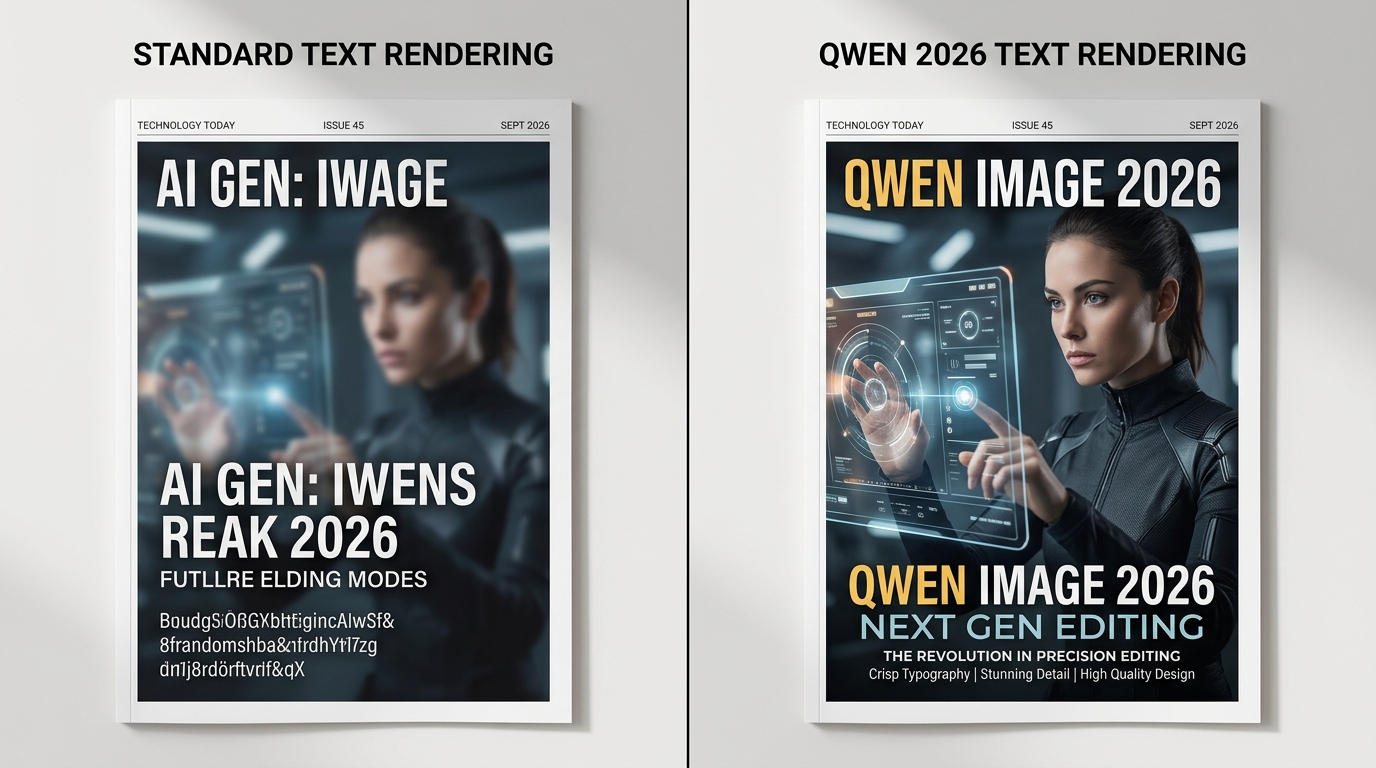
Visual Comparison: Typography & Precise Text Rendering

Real-world benchmark rendering bilingual signage, product posters, and structured multi-object compositions.

Qwen Image 2.1 vs Midjourney Typography Benchmark
Midjourney V6 Behavior:While adept at atmospheric artistic renders, complex text strings often merge together into unreadable pseudo-Latin glyphs, requiring external Photoshop correction.
Qwen Advantage:Delivers crisp, perfectly spelled typographic characters in both English and Chinese, accurately following prompt layout constraints for ready-to-publish graphic collateral.

1. Multimodal Architecture: Qwen2 Vision-Language Transformer vs Closed Diffusion

Understanding the architectural divergence in this Qwen Image 2.1 vs Midjourney comparison is vital for evaluating both platforms. Qwen is powered by Alibaba's broader Qwen2 multimodal vision-language foundation. Unlike conventional generative image pipelines that pass text through an isolated CLIP or T5 encoder before handing latent noise to a diffusion U-Net or DiT, Qwen incorporates unified multimodal representations.

This architectural cohesion enables the model to comprehend linguistic nuances, spatial prepositions (such as “to the left of”, “underneath”, “in the background”), and complex cultural idioms. Midjourney, while undeniably polished in its proprietary aesthetic filters, operates as a closed diffusion black box with minimal transparency regarding its text-encoder grounding.

2. Img2Prompt & Reverse Image Understanding

A common requirement among digital artists and agency teams analyzing Qwen Image 2.1 vs Midjourney is img2prompt: deciphering existing visual assets to create coherent variations or extract reusable aesthetic styles. Midjourney provides a basic /describe command that generates four generic prompts. However, these suggestions often hallucinate artists' names and miss minute structural details.

Because the system is natively integrated with Qwen2 vision-language reasoning, it performs deep visual attribute decomposition. It identifies focal depth, camera lens specifications, ambient lighting angles, color temperatures, and typography hierarchy, allowing creators to reverse-engineer prompts and synthesize pristine visuals with the Qwen Image Generator.

3. Text-Guided Inpainting & Iterative Post-Production

In professional workflows, generating an initial composition is only 20% of the effort; the remaining 80% involves targeted refinements. In the Qwen Image 2.1 vs Midjourney workflow analysis, Midjourney forces users to paint manual masks using its Discord or web “Vary Region” interface. Because it lacks a conversational memory, modifying one element frequently degrades adjacent facial features or alters the overall illumination.

With Qwen Image Editor, localized alterations are handled via conversational instructions. You can instruct the engine: “Keep the character pose unchanged, but replace the winter coat with a black leather jacket and add a rainy reflection on the street.” The model isolates semantic regions natively, maintaining structural coherence across iterations.

4. Production Costs, Openness & Automated Pipeline Integration

From a budget and enterprise scalability standpoint, this Qwen Image 2.1 vs Midjourney assessment highlights significant operational hurdles in Midjourney. Its pricing starts at $10/month and scales up to $60/month per user, without any programmatic API access for enterprise software integration.

Conversely, the open weights are accessible under permissive community terms. Startups and enterprise developers can run private instances locally on NVIDIA GPUs (via ComfyUI or HuggingFace Diffusers) or integrate cost-effective REST APIs hosted on serverless infrastructure. For everyday creators, our platform provides immediate free online access with our online AI photo editor without Discord subscription barriers.

Decision Guide: Which Generative Engine Fits Your Needs?

Selecting in the Qwen Image 2.1 vs Midjourney decision depends on your specific creative or commercial objectives.

Choose Qwen if you require:

  • Exact bilingual typography, marketing slogans, and legible branding signage.
  • Conversational localized inpainting and prompt-guided image modifications.
  • Multimodal image understanding, visual reasoning, and img2prompt capabilities.
  • Open model weights, REST API automation, and free browser-based testing.

Choose Midjourney V6 if you require:

  • Signature painterly, surrealist, or high-fantasy illustrative aesthetics.
  • Exploratory moodboards where exact literal prompt adherence is secondary.
  • Cinematic atmospheric lighting presets out of the box with zero fine-tuning.
  • Discord community exploration and public community prompt showcases.

Frequently Asked Questions: Qwen Image 2.1 vs Midjourney

Clear answers addressing core architectural differences, pricing, multimodal capabilities, and graphic design use cases.

The foundational difference in this Qwen Image 2.1 vs Midjourney comparison lies in model architecture and purpose. Qwen is built upon the Qwen2 multimodal vision-language architecture, excelling at legible typography, strict prompt adherence, conversational inpainting, and automated workflows via open APIs. Midjourney is a closed, proprietary text-to-image generator celebrated for atmospheric fantasy styling, but lacks public developer APIs and localized text editing.
Yes, Qwen2 is a comprehensive multimodal vision-language family developed by Alibaba. Unlike traditional diffusion models that rely strictly on separate text encoders like CLIP or T5, the Qwen engine utilizes unified vision-language transformers. This architecture enables native visual question answering, img2prompt capabilities, bilingual semantic comprehension, and surgical localized image alterations through direct human instructions.
While Midjourney provides a basic "/describe" command that returns four rough prompt guesses based on standard CLIP embeddings, the Qwen multimodal vision encoder performs deep structural img2prompt decomposition. It can accurately extract camera focal length, lighting setups, color palettes, artistic styles, and text elements from any uploaded image for prompt replication.